

STM32H747HIX6 vs STM32H723VET6: Compare STM32 Microcontroller
yunying Release time:2024-01-24 Page View:495
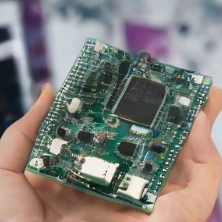
STM32H747XIH6:Dual 32-bit Arm® Cortex®-M7 up to 480MHz and -M4 MCUs, up to 2MB Flash, 1MB RAM, 46 com. and analog interfaces, SMPS, DSI
STM32H723VET6: ARM Microcontrollers - MCU High-performance & DSP DP-FPU, Arm Cortex-M7 MCU 512 Kbytes Flash, 564 Kbytes RA performance & DSP DP-FPU, Arm Cortex-M7 MCU 512 Kbytes Flash, 564 Kbytes RA
In this article, we will delve into a detailed comparison of STM32H747XIH6 vs STM32H723VET6 these two microcontrollers, exploring their features, pinouts, diagrams, and more.
- STM32H747HIX6 vs Description
- STM32H723VET6 Description
- STM32H747HIX6 vs STM32H723VET6 Features
- STM32H747XIH6 vs STM32H723VET6 Package Outline
- STM32H747XIH6 vs STM32H723VET6 CAD-Model
- STM32H747XIH6 vs STM32H723VET6 CAD-Model
- STM32H747XIH6 vs STM32H723VET6 Applications
- STM32H747XIH6 vs STM32H723VET6 Alternatives
- STM32H747XIH6 vs STM32H723VET6 Block Diagram
- SimilaritIes
- Differences
- Product comparison
STM32H747HIX6 vs Description
What is STM32H747XIH6 ?

STM32H747XIH6 Description
STM32H747xI/G devices are based on the high-performance Arm Cortex-M7 and Cortex-M4 32-bit RISC cores. The Cortex-M7 core operates at up to 480 MHz and the Cortex-M4 core at up to 240 MHz. Both cores feature a floating point unit (FPU) which supports Arm single- and double-precision (Cortex-M7 core) operations and conversions (IEEE 754 compliant), including a full set of DSP instructions and a memory protection unit (MPU) to enhance application security.
STM32H747xI/G devices incorporate high-speed embedded memories with a dual-bank Flash memory of up to 2 Mbytes, up to 1 Mbyte of RAM (including 192 Kbytes of TCM RAM, up to 864 Kbytes of user SRAM and 4 Kbytes of backup SRAM), as well as an extensive range of enhanced I/Os and peripherals connected to APB buses, AHB buses, 2x32-bit multi-AHB bus matrix and a multi layer AXI interconnect supporting internal and external memory access.
All the devices offer three ADCs, two DACs, two ultra-low power comparators, a low-power RTC, a high-resolution timer, 12 general-purpose 16-bit timers, two PWM timers for motor control, five low-power timers, a true random number generator (RNG). The devices support four digital filters for external sigma-delta modulators (DFSDM). They also feature standard and advanced communication interfaces.
STM32H723VET6 Description
What is STM32H723VET6?
The STM32H723VET6 microcontroller is a powerful 32-bit Arm Cortex-M7 based device with a range of features suitable for various applications. Here is a summary of its key features:
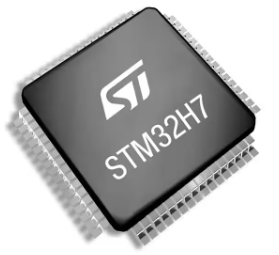
STM32H723VET6 Description
STM32H723xE/G devices are based on the high-performance Arm® Cortex®-M7 32-bit RISC core operating at up to 550 MHz. The Cortex® -M7 core features a floating-point unit (FPU) which supports Arm® double-precision (IEEE 754 compliant) and single-precision data-processing instructions and data types. The Cortex -M7 core includes 32 Kbytes of instruction cache and 32 Kbytes of data cache. STM32H723xE/G devices support a full set of DSP instructions and a memory protection unit (MPU) to enhance application security.
STM32H723xE/G devices incorporate high-speed embedded memories with up to 1 Mbyte of flash memory, up to 564 Kbytes of RAM (including 192 Kbytes that can be shared between ITCM and AXI, plus 64 Kbytes exclusively ITCM, plus 128 Kbytes exclusively AXI, 128 Kbyte DTCM, 48 Kbytes AHB and 4 Kbytes of backup RAM), as well as an extensive
range of enhanced I/Os and peripherals connected to APB buses, AHB buses, 2x32-bit multi-AHB bus matrix and a multilayer AXI interconnect supporting internal and external memory access. To improve application robustness, all memories feature error code correction (one error correction, two error detections).
The devices embed peripherals allowing mathematical/arithmetic function acceleration (CORDIC coprocessor for trigonometric functions and FMAC unit for filter functions). All the devices offer three ADCs, two DACs, two operational amplifiers, two ultra-low-power comparators, a low-power RTC, four general-purpose 32-bit timers, 12 general-purpose 16-bit timers including two PWM timers for motor control, five low-power timers, a true random number generator (RNG). The devices support four digital filters for external sigma-delta modulators (DFSDM). They also feature standard and advanced communication interfaces.
STM32H747HIX6 vs STM32H723VET6 Features
STM32H747XIH6 Features
The STM32H747XIH6 microcontroller is a high-performance device with dual-core architecture. Here is a summary of its key features:
1. Core:
- 32-bit Arm Cortex-M7 core with double-precision FPU, L1 cache, and frequency up to 480 MHz. It supports MPU, DSP instructions, and offers 1027 DMIPS/2.14 DMIPS/MHz performance.
- 32-bit Arm Cortex-M4 core with FPU, ART Accelerator™ for internal and external memory, frequency up to 240 MHz. It supports MPU, DSP instructions, and offers 300 DMIPS/1.25 DMIPS/MHz performance.
2. Memories:
- Up to 2 MB of Flash memory with read-while-write support.
- 1 MB of RAM, including 192 KB of TCM RAM (64 KB ITCM RAM + 128 KB DTCM RAM), 864 KB of user SRAM, and 4 KB of SRAM in the Backup domain.
- Dual mode Quad-SPI memory interface running up to 133 MHz.
- Flexible external memory controller supporting SRAM, PSRAM, SDRAM/LPSDR SDRAM, NOR, and NAND Flash memories.
- CRC calculation unit for data integrity.
3. Security:
- ROP (Readout Protection) and PC-ROP (PC Readout Protection) features to protect memory against unauthorized access.
- Active tamper detection for security monitoring.
4. General-purpose input/outputs:
- Up to 168 I/O ports with interrupt capability.
5. Reset and power management:
- Three separate power domains (D1, D2, D3) that can be independently clock-gated or switched off for power optimization.
- Wide voltage supply range of 1.62 V to 3.6 V for application supply and I/Os.
- Power-on reset (POR), power-down reset (PDR), power voltage detector (PVD), and brownout reset (BOR) functionalities.
- Dedicated USB power with internal regulator.
- Embedded regulator (LDO) for digital circuitry supply.
- High power-efficiency SMPS step-down converter regulator for VCORE and external circuitry.
- Voltage scaling in Run and Stop modes for power optimization.
- Backup regulator and VBAT supply for low-power modes and battery charging.
6. Low-power consumption:
- VBAT battery operating mode with charging capability.
- CPU and domain power state monitoring pins.
- Low-power modes including Sleep, Stop, Standby, and VBAT modes.
- Low standby current consumption of 2.95 µA (Backup SRAM OFF, RTC/LSE ON).
The STM32H747XIH6 microcontroller offers high performance, extensive memory options, security features, and power management capabilities. It is suitable for applications that require advanced processing power, memory-intensive operations, and efficient power consumption.
STM32H723VET6 Features
Core:
- 32-bit Arm Cortex-M7 CPU with DP-FPU and operating frequency up to 550 MHz.
- Includes L1 cache, allowing for 0-wait state execution from embedded flash memory and external memories.
- Supports MPU (Memory Protection Unit) and offers 1177 DMIPS/2.14 DMIPS/MHz performance (Dhrystone 2.1).
- Provides DSP instructions for digital signal processing tasks.
Memories:
- Up to 1 Mbyte of embedded flash memory with ECC (Error Correction Code).
- Total 564 Kbytes of SRAM, all with ECC.
- Includes 128 Kbytes of data TCM (Tightly Coupled Memory) RAM for critical real-time data.
- Offers 432 Kbytes of system RAM, with up to 256 Kbytes that can be remapped for instruction TCM RAM.
- Provides 4 Kbytes of backup SRAM available in the lowest-power modes.
- Flexible external memory controller supporting various memory types such as SRAM, PSRAM, SDRAM/LPSDR SDRAM, NOR, and NAND memories.
- Includes 2 x Octo-SPI interface with XiP (Execute in Place).
- Features 2 x SD/SDIO/MMC interfaces.
- Supports a bootloader for easy firmware updates.
Graphics:
- Includes Chrom-ART Accelerator, a graphical hardware accelerator that enhances graphical user interface performance and reduces CPU load.
- Supports LCD-TFT controller with up to XGA resolution for high-quality graphics.
Clock, Reset, and Supply Management:
- Operates with an application supply and I/O voltage range of 1.62 V to 3.6 V.
- Offers POR (Power-On Reset), PDR (Power-Down Reset), PVD (Power Voltage Detector), and BOR (Brownout Reset) functionalities.
- Provides dedicated USB power.
- Includes an embedded LDO (Low-Dropout) regulator.
- Supports various internal and external oscillators for clock generation.
Low Power:
- Includes sleep, stop, and standby modes for efficient power management.
- Offers VBAT supply for RTC (Real-Time Clock) and 32x32-bit backup registers.
Analog:
- Features 2x 16-bit ADCs (Analog-to-Digital Converters) with up to 3.6 MSPS (Mega Samples Per Second) in 16-bit resolution.
- Supports up to 18 channels and 7.2 MSPS in double-interleaved mode.
- Includes 1x 12-bit ADC with up to 5 MSPS in 12-bit resolution and up to 12 channels.
- Provides 2x comparators and 2x operational amplifiers with a gain bandwidth product (GBW) of 8 MHz.
- Includes 2x 12-bit digital-to-analog converters (DACs).
The STM32H723VET6 microcontroller offers a comprehensive set of features, making it suitable for applications that require high performance, advanced graphics, flexible memory options, and precise analog capabilities.
STM32H747XIH6 vs STM32H723VET6 Package Outline

![])_KE)VAFPILQOX3YPB3R0H](https://www.xinshop.com/upload/image/content/20240124/1c16d77d3b3a9cac1bf45898c6c8d3af.png "1c16d77d3b3a9cac1bf45898c6c8d3af.png")
STM32H723VET6
STM32H747XIH6 vs STM32H723VET6 CAD-Model

STM32H747XIH6 Symbol
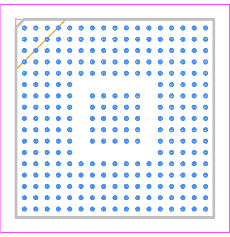
STM32H747XIH6 Footprint
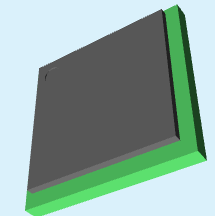
STM32H747XIH6 3D-Model
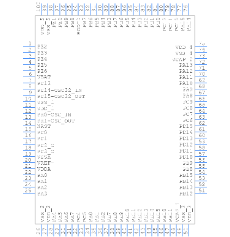
STM32H723VET6 Symbol
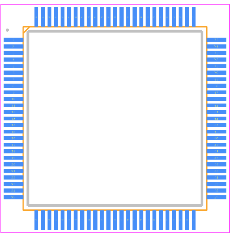
STM32H723VET6 Footprint

STM32H723VET6 3D-Model
STM32H747XIH6 vs STM32H723VET6 CAD-Model

STM32H747XIH6
STM32H747XIH6 vs STM32H723VET6 Applications
STM32H747XIH6 vs STM32H723VET6 Alternatives
STM32H747XIH6 vs STM32H723VET6 Block Diagram
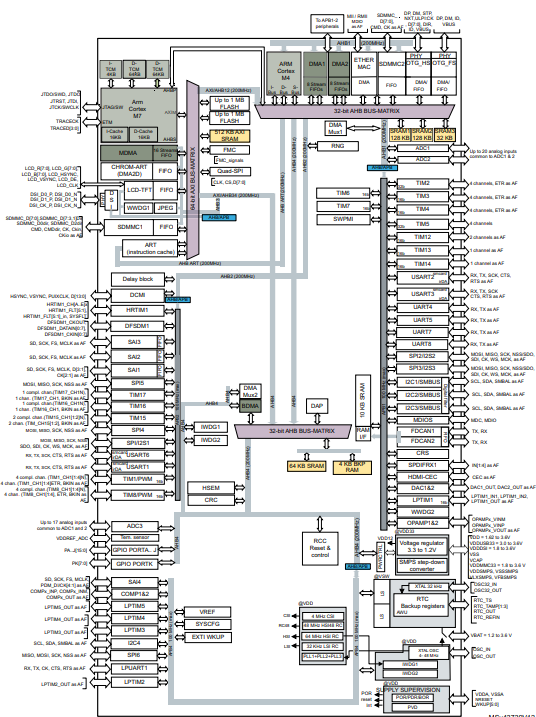
STM32H747XIH6 Block Diagram
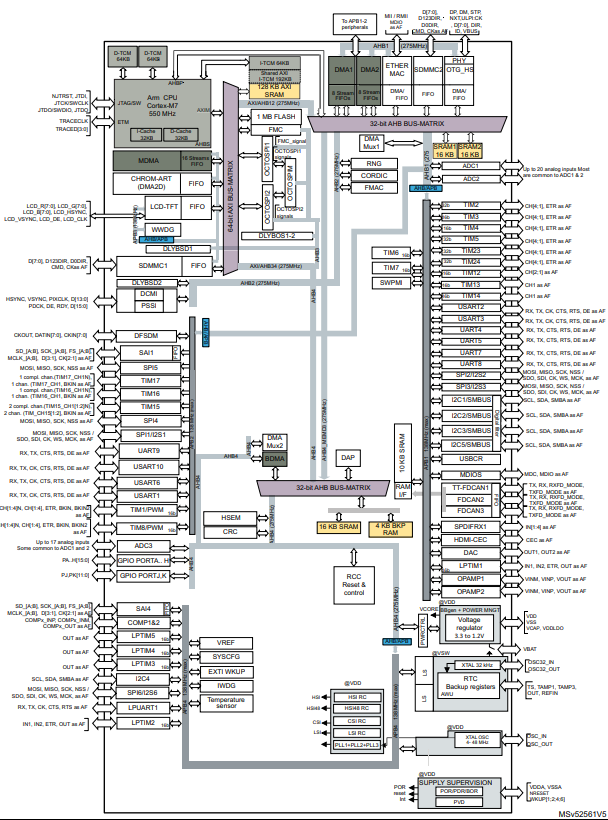
STM32H723VET6 Block Diagram
SimilaritIes
SimilarFeatures:
Both microcontrollers come with a wide array of features that cater to different application requirements. These features include:
1. Peripherals: The STM32H747HIX6 and STM32H723VET6 microcontrollers offer a comprehensive set of peripherals, including UART, SPI, I2C, USB, Ethernet, CAN, ADC, DAC, and more. These peripherals enable seamless integration with various external devices and communication protocols.
2. Advanced Connectivity: Both microcontrollers support multiple connectivity options such as Ethernet, USB OTG, and CAN. This allows for easy interfacing with different networks and communication standards.
3. Security: Security is a crucial aspect of modern embedded systems. Both microcontrollers incorporate advanced security features like hardware encryption/decryption, secure boot, and secure firmware update mechanisms, ensuring the integrity and confidentiality of data.
4. Analog and Digital Interfaces: The microcontrollers provide a rich set of analog and digital interfaces, including GPIOs, timers, DMA controllers, and analog-to-digital converters (ADCs). These interfaces facilitate the interaction with external components and enable precise control and sensing capabilities.
Differences
Differences between STM32H747HIX6 and STM32H723VET6:
1. Performance and Core:
- The STM32H747HIX6 operates at a frequency of up to 480 MHz, while the STM32H723VET6 operates at a frequency of up to 550 MHz. This makes the STM32H723VET6 slightly faster.
- The STM32H747HIX6 features a dual-core architecture with Cortex-M7 and Cortex-M4 cores, while the STM32H723VET6 has a single Cortex-M7 core. The dual-core architecture of the STM32H747HIX6 allows for simultaneous execution of multiple tasks.
2. Memory:
- The STM32H747HIX6 offers more embedded flash memory with ECC, providing up to 2 MB of storage, compared to the STM32H723VET6, which offers up to 1 MB of embedded flash memory with ECC.
- The STM32H747HIX6 also has more SRAM, with a total of 1 MB compared to the 564 KB of SRAM in the STM32H723VET6.
3. Graphics:
- The STM32H747HIX6 features a Chrom-ART Accelerator, which is a graphical hardware accelerator that enhances graphical user interface performance. The STM32H723VET6 does not have this accelerator.
4. Analog:
- The STM32H747HIX6 does not specify the number of ADC channels, while the STM32H723VET6 supports up to 18 channels.
- The STM32H747HIX6 does not specify the maximum ADC sample rate, while the STM32H723VET6 supports up to 3.6 MSPS in 16-bit mode and up to 5 MSPS in 12-bit mode.
From the perspective of applications:
- The STM32H747HIX6 with its dual-core architecture and larger memory capacity is suitable for applications that require high processing power and multitasking capabilities. It is well-suited for applications such as industrial automation, robotics, and complex embedded systems.
- The STM32H723VET6, with its slightly higher frequency and sufficient memory capacity, is also suitable for a wide range of applications but may be more appropriate for applications where the dual-core architecture and larger memory size of the STM32H747HIX6 are not necessary.
Alternatives:
- Depending on the specific application requirements, alternative microcontrollers from STMicroelectronics or other manufacturers could be considered. Some alternatives within the STM32H7 series include STM32H745/755 and STM32H750/755 microcontrollers, which offer different combinations of performance, memory, and peripherals.
- Microcontrollers from other manufacturers, such as NXP, Texas Instruments, or Microchip, also offer a range of options with different features and capabilities that can be evaluated based on specific application requirements.
In conclusion, while both the STM32H747HIX6 and STM32H723VET6 microcontrollers share some common features, they differ in terms of performance, memory, and specific functionalities. Choosing between them depends on the specific application requirements, with the STM32H747HIX6 providing more processing power and memory, while the STM32H723VET6 offers a balance of performance and features suitable for a wide range of applications. Exploring alternatives from both STMicroelectronics and other manufacturers can help identify the best fit for a particular project.
Product comparison
-
ImagePart NumberManufacturerToleranceVoltage - RatedProduct StatusPackage / CaseProduct CategoryView Compare
-
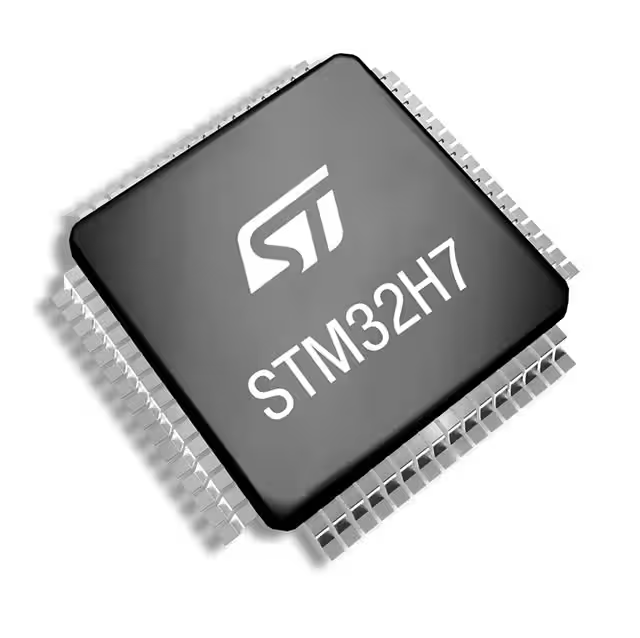
-
-
-
LQFP-100
Microcontrollers
-
-
-
-
265-TFBGA
Microcontrollers
-
-
-
-
265-TFBGA
Microcontrollers
- Share this post
-


Frequently Asked Questions
What is STM32H747XIH6?
STM32H747HIX6: The STM32H747HIX6 microcontroller is a high-performance device that operates at a frequency of up to 480 MHz. It boasts a generous 2 MB of Flash memory and 1 MB of RAM, providing ample storage and execution space for complex applications. This microcontroller also features a dual-core architecture with an Arm Cortex-M7 core running at 240 MHz and an Arm Cortex-M4 core running at 240 MHz, enabling simultaneous execution of multiple tasks.
What is STM32H723VET6?
STM32H723VET6: On the other hand, the STM32H723VET6 microcontroller is a versatile device that operates at a frequency of up to 550 MHz. It offers 512 KB of Flash memory and 564 KB of RAM, providing sufficient resources for various applications. This microcontroller features a single Arm Cortex-M7 core running at 550 MHz, delivering excellent performance for demanding tasks.
Related Articles

DRV8908QPWPRQ1 Motor Driver Datasheet,Pinout,Specification
LIS3DHTR Accelerometer for Your Projects
TMS320F28335PGFA Datasheet, Pinout, Specification
NE555 vs NE5532:Comparison for Electronics Enthusiasts
NE5532 vs OPA1612 Op-Amp: Choosing Your Right One
STM32 STM32G070RBT6 Datasheet for Embedded Systems
ADM2587EBRWZ RS-485/RS-422 Transceiver:Datasheet
CH340 vs CP2102 vs CH341 vs FT232 Differences
LM324 Op amp Pinout,Datasheet,Spec,Circuit:How to Test LM324?
What Is The Difference Between 7812 And 7805?PDF,Price,Pinout
-
1,000+Daily Order Quantity
-
2,500,000+Alternative Parts
-
2,200+Worldwide Manufacturers
-
10,000 ㎡In-stock Warehouse


